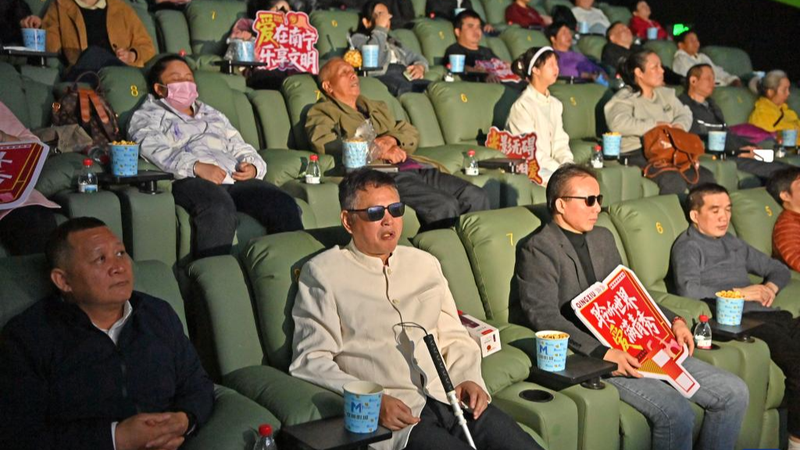
Ever wondered how movies come alive for people who can’t see the screen? Yesterday morning in Beijing, the capital of the Chinese mainland, visually impaired film fan Xu Wei and 40 others packed into a Xicheng District community center to “watch” the street dance flick One and Only. 🎥
But this wasn’t your typical screening. During the quiet gaps, a detailed voiceover painted every scene—from city alleys and dance battles to the actors’ expressions and moves. It’s called audio description, and Guangming Cinema is making it happen. 🔊
Guangming Cinema, a volunteer-driven nonprofit whose name literally means “light and brightness,” teamed up with more than 100 community centers to mark International Day of Persons with Disabilities on December 3. The goal? Bring accessible films to the estimated 17 million+ visually impaired people across the Chinese mainland.
Turns out, turning a standard 90-minute movie into an audio-described experience takes serious dedication. Volunteers from the Communication University of China watch the film ten times, write a 20,000–30,000 character script, then spend 28 days in studios with mentors and visually impaired participants to nail every line and sound cue.
“I’ve been here four times,” says Xu. “This version lets not just those with vision loss, but also people with physical or cognitive challenges, enjoy movies more fully.”
The feedback loop has supercharged quality. A volunteer recalls being asked by a child in the audience, “What is the color red?” That simple question led narrators to rethink how they describe visuals, focusing on sound, texture, and emotion. Now, the narration is more immersive and three-dimensional. 🤝
Guangming Cinema has already released over 800 audio-described films—from blockbusters to animations and thrillers—and its reach is growing. They partner with disability groups and special-ed schools nationwide, sending secure hard drives loaded with accessible movies to all 2,244 special education schools. Many titles are free on cable and online platforms.
According to project lead Fu Haizheng, survey data shows the willingness of visually impaired audiences to watch these films jumped from 13% to 63% in just a few years. It’s not just about movies—it’s about connection. “Chatting with friends after a screening adds color to our lives,” says Cao Jun, deputy chair of the Beijing Association of the Blind.
Looking ahead, Guangming Cinema aims to expand its audio guidance beyond films to exhibitions, museums, and other cultural experiences—making the arts truly accessible for everyone. 💡
Reference(s):
How a Chinese company makes movies accessible to the visually impaired
cgtn.com