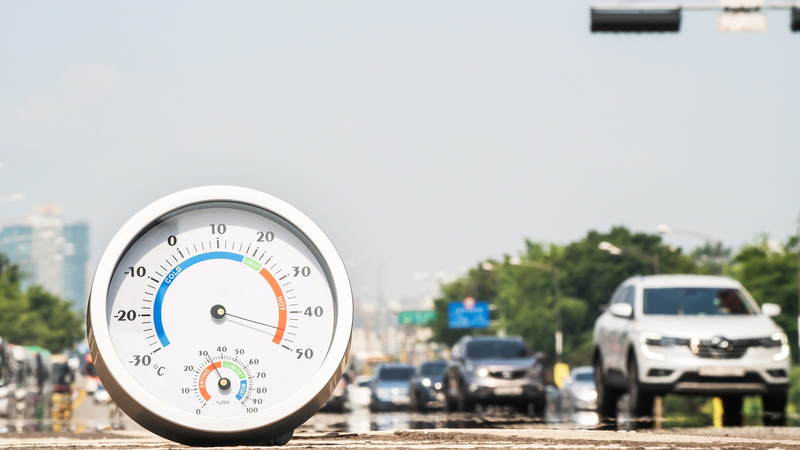
🔥 Feeling the heat in your city? You’re not alone! A new study from the Northwest Institute of Eco-Environment and Resources under the Chinese Academy of Sciences dives into how surface heat sources in major urban clusters fuel those sweltering heatwaves we’re all dreading. 🌡️
🔍 The research team, led by Gao Xiaoqing, analyzed four key urban clusters in mainland China this year: the Beijing-Tianjin-Hebei region, the Pearl River Delta, the Yangtze River Delta, and the Chengdu-Chongqing region. They mapped the temporal and spatial shifts of surface heat sources to decode their link with compound high-temperature events.
🌡️ Seasonal & regional patterns: Across all four clusters, surface heat sources are "strong in summer, weak in winter." But the details vary – in the Beijing-Tianjin-Hebei area, heat cranks up in the south and meanders out in the north (which even flips into a heat sink during winter!). Meanwhile, the Yangtze River Delta sees its hottest spots along the rivers, while big cities surprisingly show lower surface heat levels.
📊 Why it matters: Changes in these heat sources are strongly tied to how often we hit compound high-temperature events (think back-to-back scorching days), though they don’t necessarily crank up the peak temperature every time.
🌳 What can we do? While the study focuses on those Chinese mega-clusters, the takeaways hit home for cities across South and Southeast Asia – from Mumbai’s asphalt streets to Jakarta’s waterfronts and Bangkok’s concrete jungles. Smarter urban planning, more green cover, reflective roofs, and better surface energy management can help turn down the thermostat.
💡 Bottom line: As urban clusters keep growing, understanding surface energy is key to boosting our cities’ climate resilience and keeping life livable. Time to cool things down, one rooftop at a time! 🌱
Reference(s):
Study reveals how urban heat sources intensify extreme heat events
cgtn.com