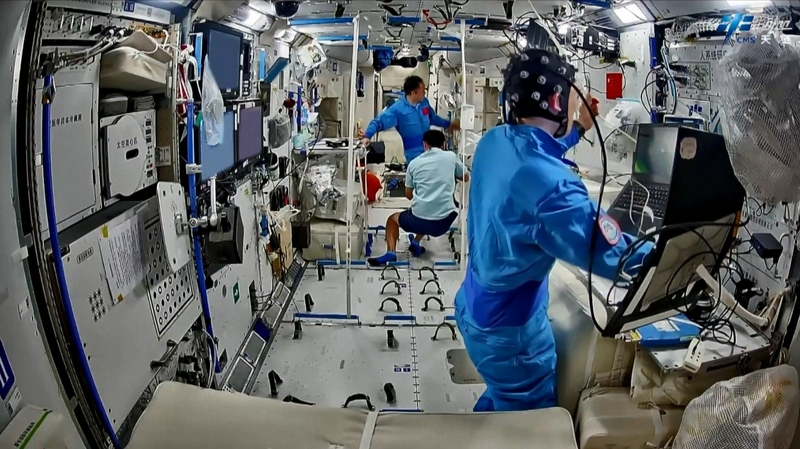
Almost two months ago, on November 1, 2025, China blasted off its Shenzhou-21 mission 🚀. Aboard the orbiting space station, mission commander Zhang Lu, flight engineer Wu Fei and payload specialist Zhang Hongzhang (all three types of Chinese taikonauts!) have been busy turning the station into a high-tech lab.
Brainwaves & Emotions 🧠
In aerospace medicine, the crew is using EEG headsets to track brain activity for studies on metacognition (fancy word for thinking about thinking) and how crew members manage emotions in space. All that data helps researchers back on Earth understand how microgravity affects our brains.
Growing Plants in Orbit 🌱
In the Wentian lab module, the team is collecting samples of Arabidopsis thaliana—basically the lab rat of the plant world. By analyzing the molecular signals that regulate its stem cells, scientists hope to unlock secrets for sustainable farming both on Earth and, someday, other planets.
Fluid Physics & Fire Experiments 🔥
Microgravity makes fluids behave oddly—think swirling blobs instead of neat flows. The crew disassembled and reassembled the fluid physics cabinet to swap samples, then tackled combustion tests by replacing gas sampling covers and cleaning the containerless chamber. They even tuned up electrodes in the axial mechanism.
Battery Science in Space 🔋
Amazing work is happening in the in situ electrochemical optical research on lithium-ion batteries. Payload specialist Zhang Hongzhang is capturing real-time images of lithium dendrite growth—tiny metal filaments that can short-circuit batteries. These insights could lead to safer, longer-lasting power packs for our devices and future space missions.
Health Check-ups Up Here 💉
The trio also completed medical exams—bone density scans, ECGs, blood pressure checks and vision tests—to keep tabs on their health in zero g.
From EEG headsets to plant sampling, Shenzhou-21 is pushing the boundaries of space research and making science look like a cosmic adventure. Stay tuned for more updates as these taikonauts continue their epic orbit!
Reference(s):
cgtn.com