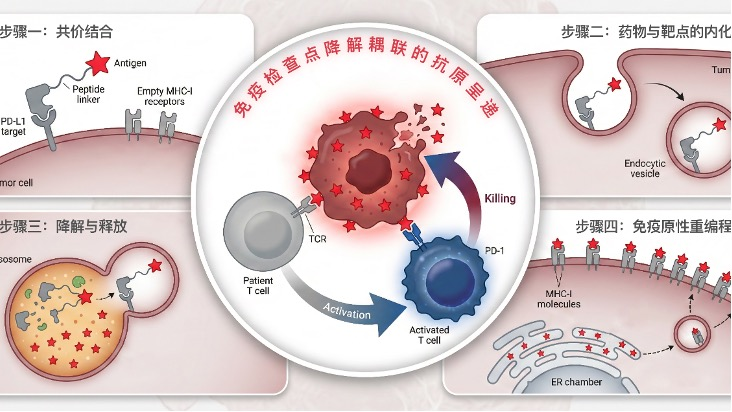
Ever thought about attacking cancer from the inside out? 🔬💥 Meet iVAC, a next-gen intratumoural vaccine developed by Peng Chen's team at Peking University. Instead of blasting tumors from outside, iVAC sneaks in and exposes cancer cells to your immune system like never before.
Why tumors play hide-and-seek
Your T cells are the body's security guards, on the lookout for abnormal cells. Cancer cells usually wear molecular fingerprints that say I don't belong here. But some tumors go immune-cold by showing PD-L1, a dont-shoot signal that confuses T cells. The result? Tumors grow unchecked, and many patients miss out on immunotherapy benefits.
Inside-out strategy
After 4 years of tinkering, the team created iVAC—a small 18 kDa molecule that penetrates deep into solid tumors. It has a covalent nanobody that latches onto PD-L1, tricks the cancer cell into swallowing the whole complex, and drags PD-L1 into the lysosome (the cell's recycling center). Inside, PD-L1 is broken down, and antigen fragments pop up on the cell surface like bright neon ID tags. Suddenly, hidden tumors light up for T cells to attack! 🎯
This Trojan Horse-style vaccine could shift the immunotherapy game, especially for patients across Asia facing immune-cold cancers. While clinical trials are still on the horizon, iVAC shines as a creative leap in biotech—proof that hacking cancer's own machinery might be the key to victory. 🌟
Stay tuned as science turns the tables on tumors and brings hope to millions. From Mumbai to Manila, this breakthrough could redefine how we fight cancer.
Reference(s):
cgtn.com