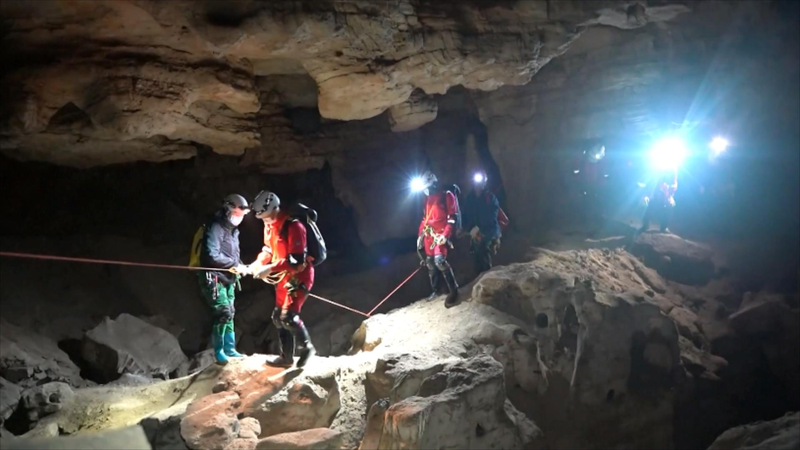
Ever wondered how astronauts gear up for the pitch-black silence of space? Imagine exploring Malaysia's Batu Caves—but with temps at 8°C, 99% humidity and no sunlight for days! That’s exactly what 28 Chinese astronauts did on a recent 6-day, 5-night cave mission in Chongqing's remote Wulong District. 🕳️❄️
Split into 4 teams, they learned to check air quality (environmental monitoring), map the cave's twists and turns, and run “space-to-ground” comms—like livestreaming from underground. They also tackled team logistics and life-support tasks, all under total darkness and damp conditions. 🎙️🗺️
Crawling through narrow chutes, rappelling sheer walls, and battling the cold, they pushed their bodies to the limit. Plus, they faced absolute darkness and sensory deprivation—no GPS, no signal, just your heartbeat and breath. 💓🔇
Song Lingdong (Shenzhou-19 veteran) says the harsh setting leveled up their teamwork: “We bonded fast and stayed hyped to complete every challenge together.” 🤝🔥
Zhu Yangzhu (Shenzhou-16) flipped off all lights to soak in pure darkness: “In that pitch-black, you really feel like you’re floating in space—your own heartbeat is the loudest thing you hear.” 🌌
Commander Tang Hongbo (Shenzhou-17) led the mission underground: “Keeping everyone safe in those conditions was intense—my mind was racing every second.”
Liu Yang, first Chinese woman in space (Shenzhou-9 & -14), says exiting the cave felt like touchdown after a mission: “We all cheered, thrilled to report success to our team.” 🎉🚀
Since 2016, the China Astronaut Research and Training Center has scouted caves across Guangxi, Guizhou, Hunan, Anhui and Chongqing. Wulong’s cave scored highest on challenge and safety, making it the ultimate training ground. More cave missions are lined up for new recruits and anyone who missed out. Ready to go underground? 🌍⚒️
Reference(s):
Chinese astronauts detail cave training for extreme environments
cgtn.com