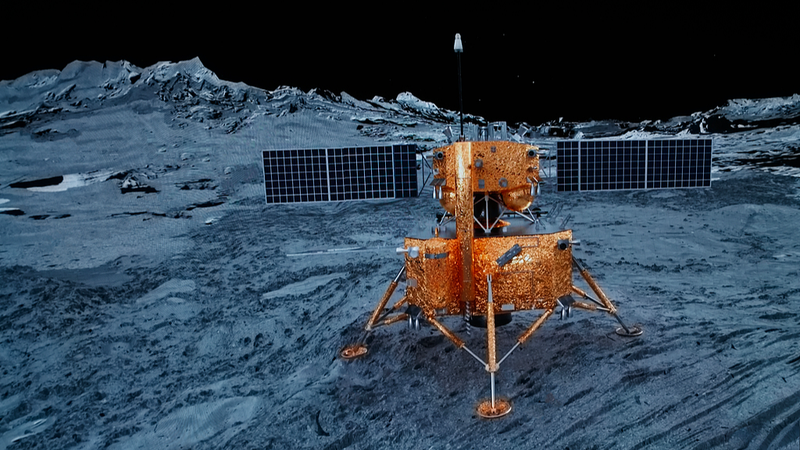
Hold up, space explorers! On January 20, 2026, the China National Space Administration (CNSA) announced that the Chang'e-6 mission has confirmed, for the first time ever, the existence of naturally occurring single-walled carbon nanotubes and graphitic carbon on the far side of the moon 🌙.
In super simple terms, carbon nanotubes are tiny tubes made of carbon atoms that are a few nanometres wide – about 100,000 times thinner than a hair. They’re known on Earth for being super strong and lightning-fast at conducting electricity, making them a hot topic in next-gen tech like flexible electronics and advanced batteries ⚡.
So how did these nanotubes form out there? Researchers from Jilin University, in a study published in Nano Letters, point to a wild combo: constant micro-meteorite impacts, ancient volcanic vents, and solar wind irradiation. Under these extreme conditions, iron acted like a catalyst, stitching carbon atoms into these nanotube structures.
Interestingly, when scientists compared samples from Chang'e-6 on the moon’s far side to those from Chang'e-5 on the near side, they found more "defects" in the far side’s carbon structures. That likely comes from higher meteorite traffic on the far side, hinting that this region has its own unique geological story.
Why it matters: this discovery could spark a paradigm shift in carbon science, opening fresh pathways to engineer revolutionary materials. Think stronger composites, smarter sensors, or even self-healing electronics inspired by lunar nanotubes 🚀.
This breakthrough shows there’s still so much to learn beyond Earth. With every mission, we’re rewriting the book on lunar science – and it’s only just begun! ✨
Reference(s):
China achieves first discovery of carbon nanotubes on the moon
cgtn.com